Uncategorized
Ground-Level Dholera 2025 Reality: Infrastructure and Investment Move from Plans to Execution
 Uncategorized
Ground-Level Dholera 2025 Reality: Infrastructure and Investment Move from Plans to Execution
Ground-level developments across Dholera Smart City in 2025 indicate a clear transition from long-term planning to physical infrastructure execution and early-stage operations. Multiple core projects that had remained in conceptual or preparatory stages for years are now visibly taking shape on the ground.
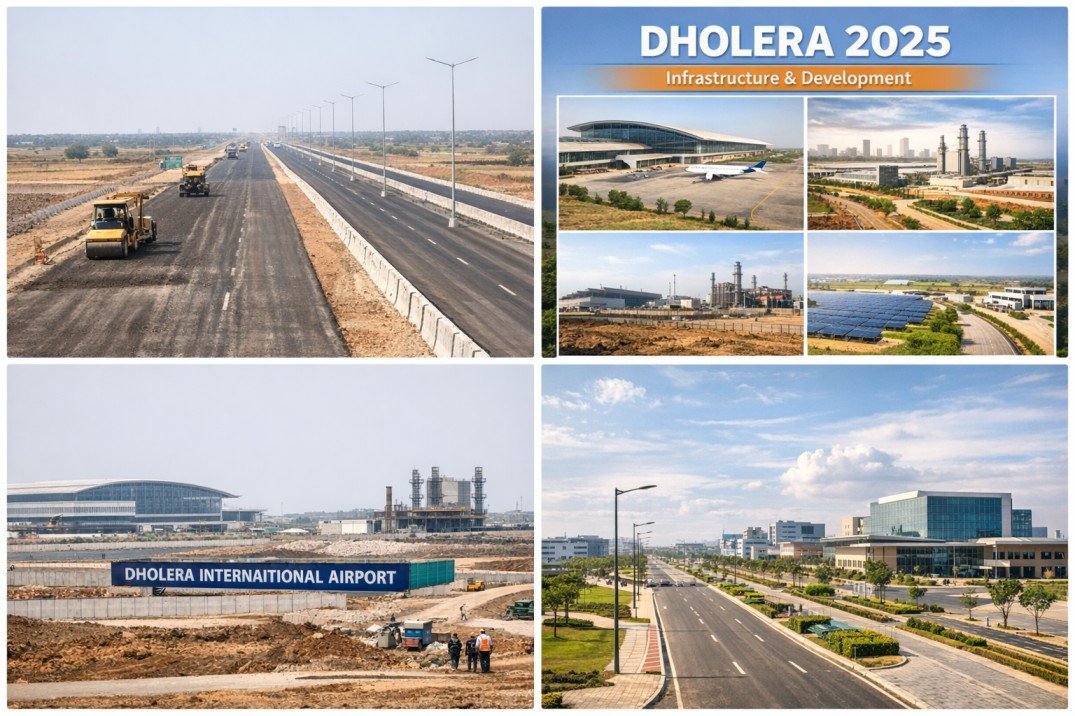
One of the most significant indicators of this shift is the near completion of the Ahmedabad–Dholera Expressway. Construction activity along the corridor is largely finished, with interchanges, service roads, and supporting infrastructure progressing steadily. The expressway is expected to dramatically reduce travel time between Ahmedabad and Dholera, improving access for investors, workers, and logistics operators.
At the same time, the Dholera International Airport project has advanced into active construction phases. Site development, boundary works, and early infrastructure components are underway, reinforcing Dholera’s role as a future aviation and cargo hub linked to industrial clusters and global supply chains.
Within the Activation Zone, internal roads, underground utilities, drainage systems, and smart infrastructure are now operational or nearing readiness. These developments are designed to support the first wave of industrial units, commercial facilities, and residential projects, making the city investment-ready rather than purely aspirational.
Early industrial projects — including semiconductor-linked facilities, electronics supply units, logistics hubs, and renewable energy infrastructure — have begun moving into execution stages. These projects signal the start of real economic activity, supported by reliable power, water supply, and transport connectivity.
Officials and industry observers note that Dholera’s progress in 2025 reflects coordinated execution across multiple agencies, including central and state authorities, DMIC institutions, and infrastructure developers. This alignment has reduced project delays and improved investor confidence.
Real estate activity has also evolved alongside infrastructure execution. Rather than speculative interest, demand is increasingly driven by proximity to expressway access points, activation infrastructure, and upcoming employment zones — highlighting a shift toward infrastructure-aligned investment behavior.
Overall, the ground-level reality in 2025 suggests that Dholera is moving beyond vision statements and master plans toward becoming a functional smart industrial city, with tangible infrastructure and investment foundations now in place for sustained growth in the coming years.