Is Dholera Ready to Live In? Housing, Hospitals, Schools, Hotels & Daily-Life Infrastructure in 2026
Dholera is best known for its semiconductor fab, industrial development, airport, expressway and smart-city infrastructure. But as more companies and workers prepare to enter the region, a more practical question is becoming important:
Is Dholera actually ready for people to live in during 2026?
The answer is not simply yes or no.
Dholera’s social infrastructure is advancing, but several important facilities are still being commissioned, operationalised or expanded. Housing, healthcare, education, hospitality, food services and transport are all moving forward, but the city is not yet comparable with a mature urban centre such as Ahmedabad.
Here is the latest picture.
Dholera Is Moving Beyond Industrial Infrastructure
Dholera Special Investment Region was planned as more than an industrial zone.
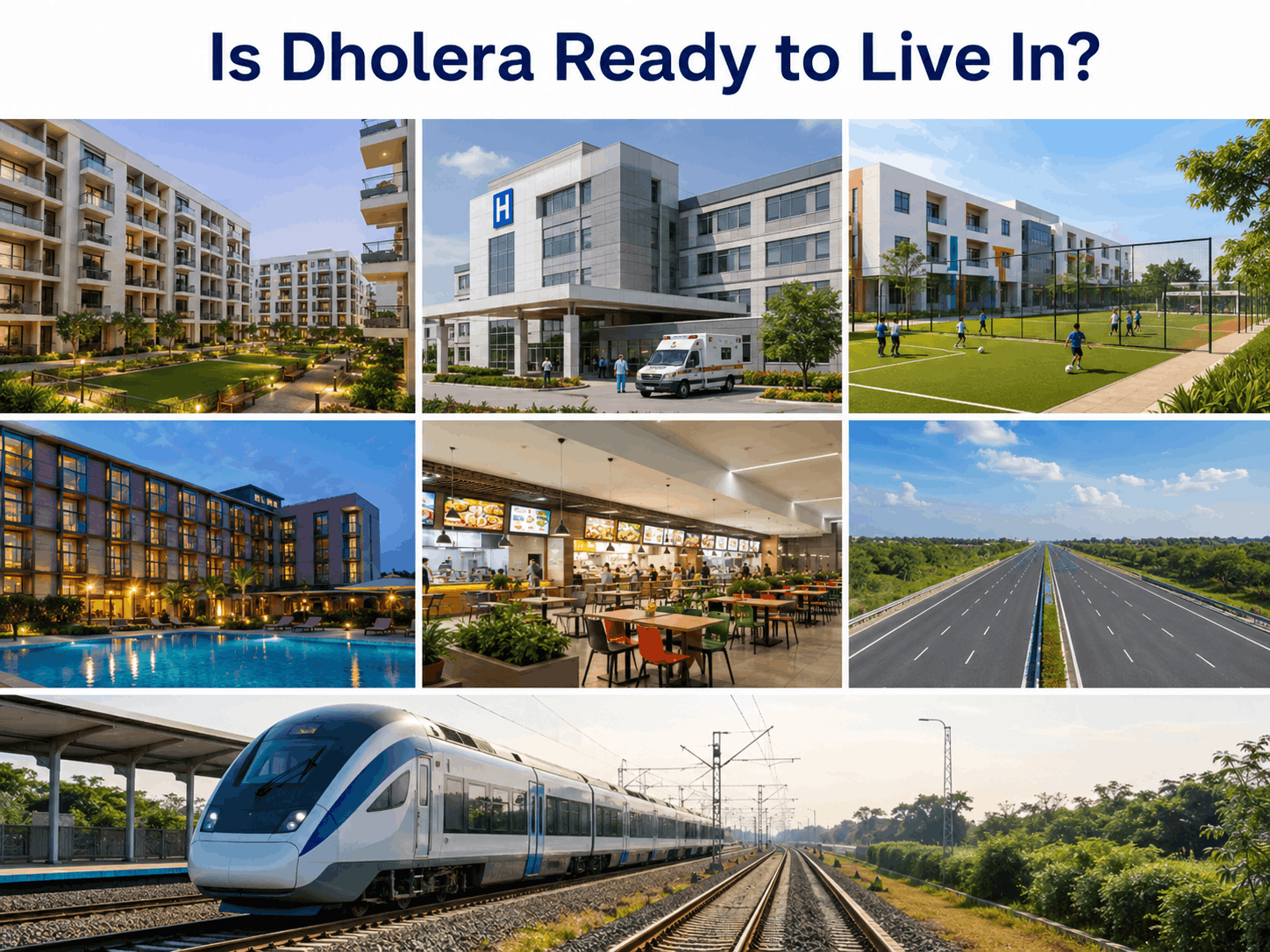
Government updates identify social infrastructure such as a multispeciality hospital, integrated school, fire station, premium guest accommodation, residential and commercial developments, and hospitality facilities as part of the city’s broader development plan.
This is important because major projects such as Tata Electronics’ semiconductor fab are expected to create significant employment demand. The notified semiconductor SEZ alone is expected to support around 21,000 direct and indirect jobs.
As jobs increase, demand for housing and daily-life services is likely to grow as well.
Healthcare: Hospital Infrastructure Is Built, Operations Are the Next Step
Healthcare is one of the most important factors in determining whether a new city is truly livable.
Dholera’s planned social infrastructure includes a 200-bed multispeciality hospital. Official government material confirms the hospital as part of the city’s social development programme.
In 2026, DICDL moved toward operationalising the healthcare facility by inviting private partners for commissioning and management. Reporting on the tender states that the first phase is planned with around 100 beds, with services expected to include emergency care, general surgery, paediatrics and related facilities.
This means the healthcare infrastructure has progressed substantially, but it should not yet be described as a fully mature operating hospital ecosystem.
Schools: Education Infrastructure Is Progressing
Families planning to live in Dholera will also need access to schools.
An integrated school has been developed in the Activation Area and is planned to provide education from Nursery to Class XII. The proposed operating model includes affiliation with a recognised board and supporting academic and sports infrastructure.
The target reported for the school is to begin academic operations by the 2027–28 academic year.
For families moving in during 2026, this means local education options should still be checked carefully rather than assuming the new school is already fully operational.
Housing: Dholera Is Entering the Built-Development Stage
Housing is one of the clearest signs that Dholera is moving from planning into occupancy.
Official sources have already highlighted residential and commercial development as part of the city’s social-infrastructure plan.
Private development is also increasing.
In September 2026, GAP Group said it was preparing to deliver around 250 studio apartments, along with a co-working space and food court, by the end of the year. The announcement reflects a broader shift from plotted-land investment toward actual built residential and commercial projects.
This is a significant change for Dholera.
As industrial jobs increase, demand is expected to grow for studio apartments, rental housing, larger residences and worker accommodation.
However, housing supply is still developing and remains far smaller than what is available in established cities.
Hotels and Accommodation for Investors
Dholera also needs short-term accommodation for investors, business teams, engineers and visiting professionals.
DICDL has repeatedly invited proposals for the operation and management of accommodation facilities for investors in the Activation Area. A tender issued in July 2026 closed in August, showing that the focus has moved from construction toward preparing facilities for actual use.
Official planning also includes premium guest accommodation and hospitality facilities.
This does not mean Dholera already has the depth of hotels found in Ahmedabad, but the accommodation ecosystem is clearly expanding.
Food, Retail and Everyday Convenience
A livable city also needs food outlets, pharmacies, grocery stores and everyday services.
DICDL has invited operators for a food court in the Activation Area, another sign that day-to-day urban services are being prepared.
Private developers are also beginning to plan food, co-working and commercial facilities alongside housing.
Still, Dholera should not yet be viewed as a fully developed retail destination.
As population and workforce numbers rise, private restaurants, shops, convenience stores and service businesses are likely to follow.
Safety and Emergency Infrastructure
A dedicated fire station is also part of Dholera’s social-infrastructure planning.
This is especially important for a city designed around advanced manufacturing and industrial activity.
Emergency services, utilities and centralised urban management will be important parts of Dholera’s long-term livability.
Connectivity Has Improved Significantly
One major advantage for people working in Dholera is better connectivity with Ahmedabad.
The 109-km Ahmedabad–Dholera Greenfield Expressway was inaugurated on March 31, 2026. NHAI says the corridor improves access to Dholera SIR and the upcoming Dholera International Airport while reducing travel time and improving movement of people and goods.
Rail connectivity is also set to improve.
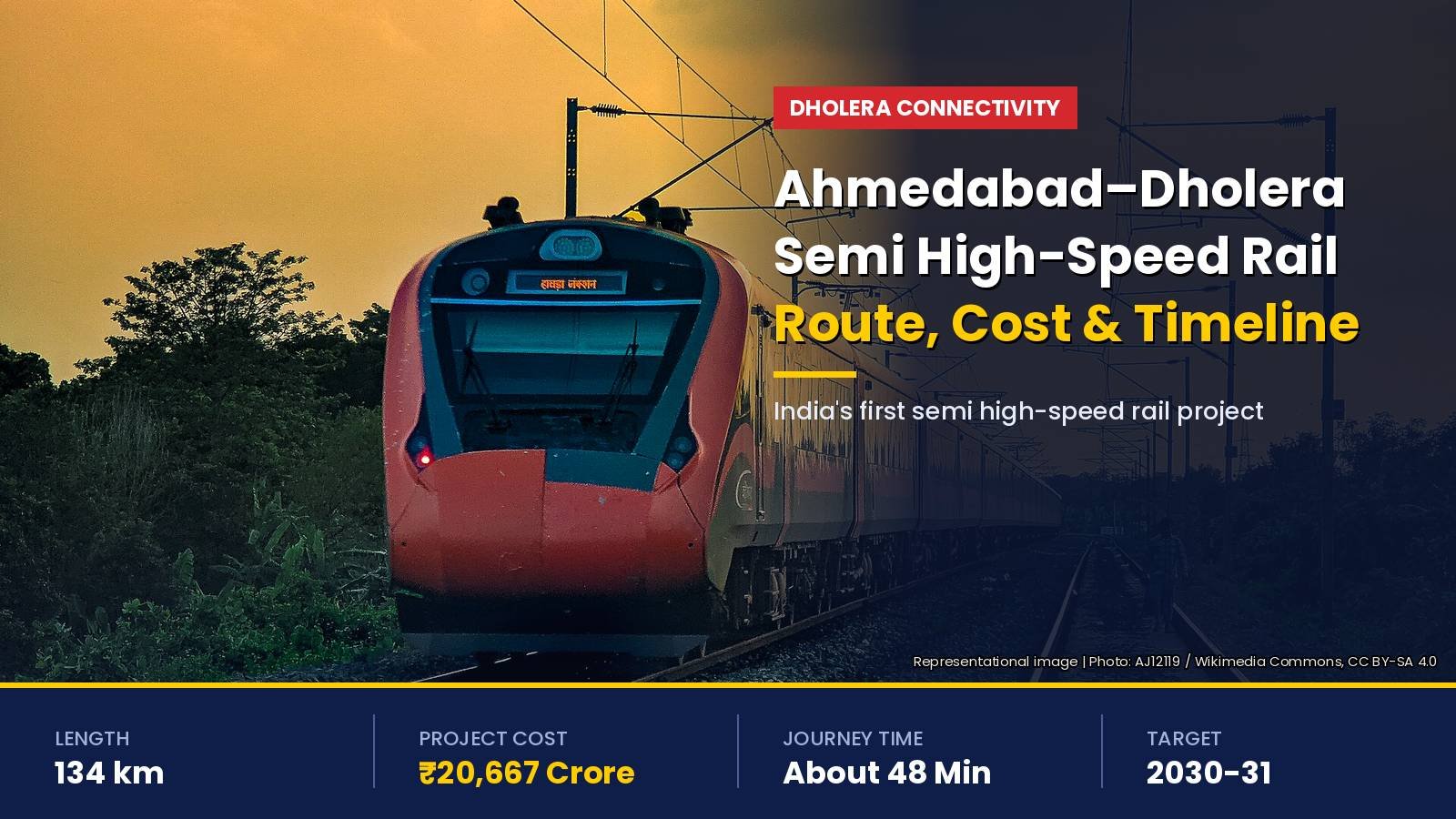
The Union Cabinet approved the 134-km Ahmedabad (Sarkhej)–Dholera Semi High-Speed Double Line in May 2026 at an estimated cost of around ₹20,667 crore. The project is planned to connect Ahmedabad, Dholera SIR, Dholera Airport and Lothal, with completion targeted by 2030–31.
Together, these projects could make commuting and business travel more practical while Dholera’s own residential ecosystem develops.
So, Is Dholera Ready to Live In?
The most accurate answer is:
Dholera is becoming increasingly livable, but it is still in a transition phase.
The city now has much stronger infrastructure than a few years ago. Housing construction is increasing, social facilities are being operationalised, connectivity has improved and industrial employment is expected to grow.
But several important services including parts of the healthcare, education, hospitality and retail ecosystem are still developing.
Professionals connected with industrial projects may find Dholera increasingly practical for work and short-term stays.
Families planning a permanent move should still verify the latest on-ground availability of schools, hospitals, shopping, food services and housing before relocating.
What Could Change Dholera’s Livability in 2026–27?
Several developments could accelerate the transition:
- More housing projects reaching completion
- Hospital commissioning and expansion
- School operations beginning
- Investor accommodation becoming operational
- Growth of hotels, restaurants and retail
- Rising employment around semiconductor and industrial projects
- Better road, rail and airport connectivity
As these elements come together, Dholera is gradually shifting from a largely infrastructure-led project toward a functioning industrial city with a growing residential ecosystem.
FAQs
Is Dholera ready for families in 2026?
Dholera is progressing, but families should still check current availability of schools, healthcare, retail and housing before relocating.
Is there a hospital in Dholera?
A multispeciality hospital facility has been developed and is moving through commissioning and operationalisation. The initial operating phase is planned at around 100 beds.
Are schools operational in Dholera?
An integrated Nursery-to-Class XII school is planned, with operations targeted by the 2027–28 academic year.
Is housing available in Dholera?
Residential development is increasing. GAP Group has announced plans to deliver around 250 studio apartments by the end of 2026, while other residential and commercial projects are also progressing.
Are hotels and guest facilities available?
Hospitality and investor-accommodation facilities are being developed and operationalised, but availability is still more limited than in established cities.
Is Ahmedabad well connected to Dholera?
Yes. The 109-km Ahmedabad–Dholera Expressway was inaugurated in March 2026, and a semi-high-speed railway project has also been approved.
Is Dholera expected to become more livable?
Yes. Housing, healthcare, education, hospitality and commercial services are all part of the city’s development plan, and growing industrial employment is expected to increase demand for these facilities.